
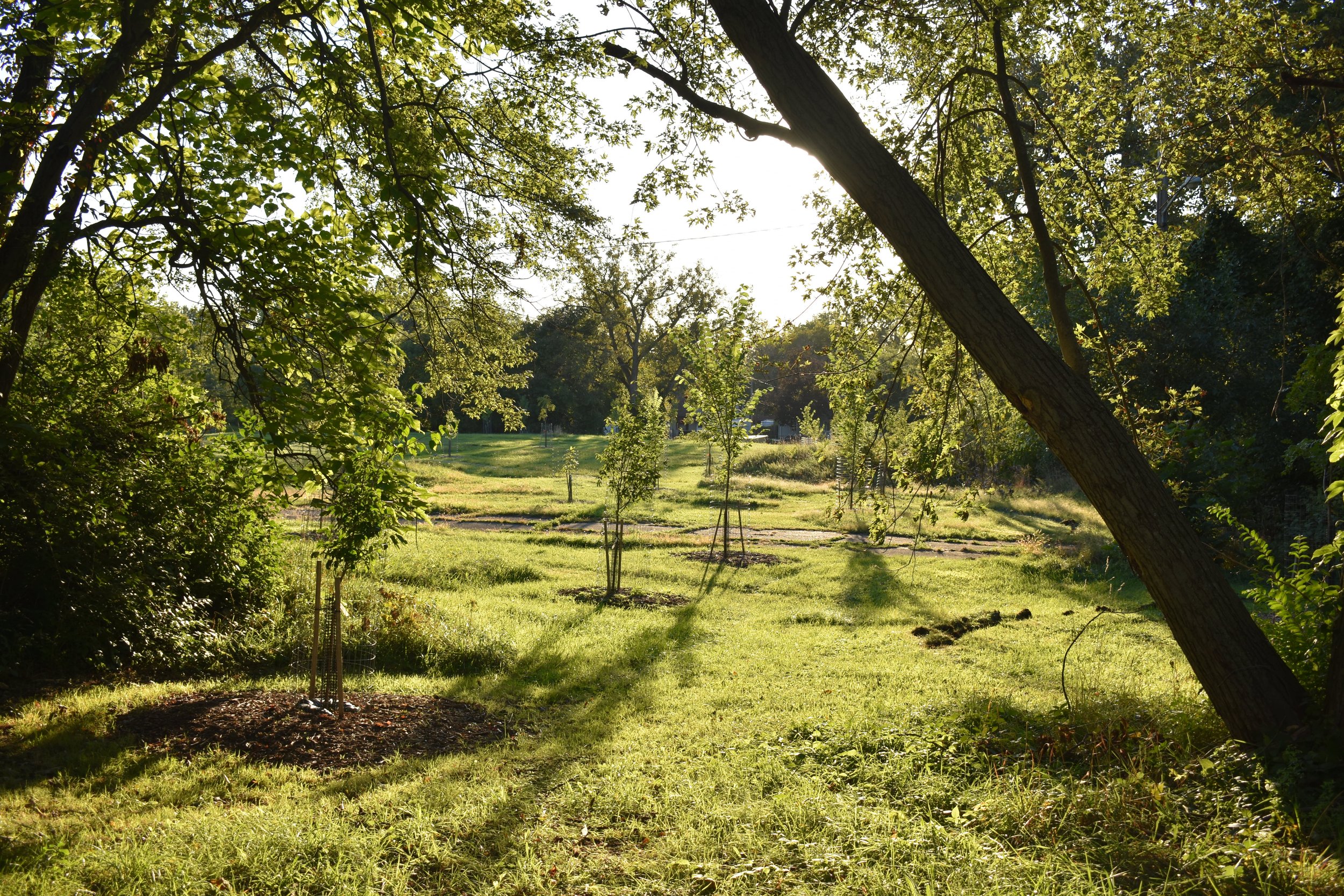
Designing Natural Areas
Cleveland owns roughly 20,000 vacant lots that are routinely mowed to meet city ordinances. This pattern book, developed by Western Reserve Land Conservancy with the City of Cleveland, lays out a different approach: reduce mowing in targeted areas and let tree canopy grow in on its own. It covers the groundtruthing process behind site selection, the maintenance services that prepare a lot for natural growth, and sample site plans co-designed with city staff across the Opportunity Corridor, St. Clair-Superior, and Buckeye-Woodhill.
Vacant Lot Tree Care Standard
These are general standards that apply to all sites unless otherwise noted on site drawings.
Reference Standard: All tree pruning work shall comply with ANSI A300 (Part 1) - Tree Care Operations: Tree, Shrub, and Other Woody Plant Management - Standard Practices (Pruning). This standard establishes the minimum requirements for safe and effective pruning practices.
Goal: Create a safe, accessible, park-like setting by removing hazardous vegetation, establishing clear sight lines, and elevating tree canopies. Preserve natural tree forms and remove only what's necessary for safety and sight lines to enhance the natural character of the site. All work shall prioritize tree health and structural integrity while meeting safety objectives
Seasonal restriction: Only prune elm or oak trees between during consistent periods of freezing temperatures (below 40°F) in the dormant winter months to prevent disease transmission (Dutch elm disease and oak wilt).
Standard Checklist:
All trees and shrubs under 4" DBH removed; contractors may flag healthy native canopy species (oak, maple, etc) under 4" DBH for potential retention if well-formed and suitably located—project manager will assess flagged trees during site visit before removal
All tree canopies elevated to minimum 10 feet where consistent with species and natural form (larger shade trees 10"+ DBH elevated to 12-15 feet; small ornamental trees pruned to maintain natural form and branching structure); branches 4" diameter and larger should remain unless they pose a safety hazard
All broken, cracked, or hanging branches 2" diameter and larger removed from all trees
All branches 2" diameter and larger with visible splits removed
All branches 2" diameter and larger showing signs of disease or decay removed
All crossing or rubbing branches 2" diameter and larger removed
All dead branches 2" diameter and larger removed from trees
All excessive suckers and water sprouts removed from tree trunks and main branches
All trees marked for removal have been removed
All stumps ground to minimum 6" below grade (grindings may remain); if grinding is not feasible due to embedded metal, rocks, or confined location, cut stump flush to ground and apply herbicide to prevent resprouting
All branches, logs, and woody debris larger than 1" diameter chipped on-site (includes both pruning debris and existing material found on site); contractor to coordinate with project manager for woodchip drop locations and handling of larger limbs that cannot be chipped
Vacant Lot Landscaping Standards
These are general standards that apply to all sites unless otherwise noted on site drawings.
Goal: Create safe, accessible, and maintainable pedestrian zones along sidewalks by clearing obstructions and creating smooth mowable surfaces. Sites should present a clean, well-maintained appearance that supports neighborhood walkability and prepares the ground for future tree planting.
Standard Checklists:
Sidewalk: Surface is completely clear and visible with a clean, defined edge and no soil buildup against it.
Sidewalk surface 100% clear of soil, grass, roots, and debris with clean vertical edge cut 1-2" depth along entire perimeter
Ground adjacent to sidewalk graded to prevent soil, water, and debris from accumulating on sidewalk surface. On flat or gently sloped sites, ground within 10' should be level with or slightly below sidewalk with no soil buildup against the edge. On steeply sloped sites , maintain a stable, vegetated slope with a minimum 2' level buffer at the sidewalk edge.
Cracked blocks (multiple cracks dividing block into 5+ pieces), heaving blocks (raised more than 1" above adjacent blocks), and missing blocks replaced or reset per City of Cleveland Specifications
Ground: Entire site has a smooth, stable surface that drains properly and can be safely maintained with a riding mower.
Standard zero-turn mower can traverse entire mowable area without bottoming out, getting stuck, or encountering obstacles
No stumps, roots, or buried debris protruding more than 2" above ground surface throughout mowable area
All concrete, asphalt, and compacted soil surface removed and decompacted
All depressions, holes, and sunken areas (including sunken basements) filled and firmed to match surrounding grade
All bare or disturbed soil seeded and covered with straw (no bare soil patches exceeding 2 square feet)
Fence: All fencing is completely removed with ground smoothed and vegetated, and trees preserved where present.
All fencing, posts, gates, and hardware removed and hauled away. When fencing intersects trees: if the tree is being preserved, fence cut flush with tree without damaging bark or roots—tree remains unharmed. If the arborist has removed the upper portion of a tree growing through the fence, the landscape contractor is responsible for removing the remaining trunk/stump along with the fence.
All post holes and footing locations filled and compacted flush with surrounding ground (no depressions deeper than 2")
Debris: Site is clean and orderly, completely free of litter, dumped materials, and construction debris.
All litter, trash, dumped items (furniture, appliances, tires, etc.), and construction debris (lumber, concrete, asphalt, metal, etc.) larger than 6” in any dimension removed and hauled away
No accumulations or piles of litter exceeding 10 pieces in any location